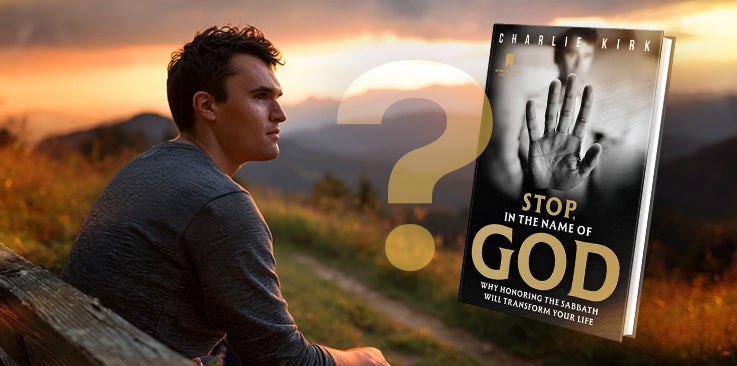
In the prologue of his posthumously published book, Stop, in the Name of God: Why Honoring the Sabbath Will Transform Your Life, Charlie Kirk states his intention to persuade the reader that the Sabbath is “essential to the flourishing of the human soul.” He goes on to say, “I desire to bring all humanity back to God’s design to rest for an entire day. To cease working, to STOP, in the name of GOD.”
Kirk began observing the Sabbath from sunset Friday to sunset Saturday in 2021 after a friend challenged him to do so, saying, “Jesus told us if we love him to follow his commandments.” Several years of Sabbath-keeping led Kirk to this conclusion: “The Sabbath is the key that unlocks civil society and a free people, and could be the secret answer to restore self-government in America.”
That’s a big statement! Did Kirk rediscover something that we’ve neglected?
Blue Law Glory Days
When recounting a brief history of the Sabbath, Kirk speaks fondly of Sunday observance by Christians during the Middle Ages, saying, “Feasting, rest, and religious devotion turned Sunday into a weekly festival of grace,” and “Sunday was not just a cessation of labor; it was the renewal of the soul.”
Perhaps when Kirk spoke of Sabbath as “the key that unlocks civil society,” he was thinking of “blue laws” in early America, which he frames in a positive light. These laws restricted business activities and enforced Sunday rest and worship.
Kirk describes them as “a legal rhythm grounded in moral vision” and says “these laws were not seen merely as religious impositions, but social goods.” He says blue laws “were designed not merely to enforce piety, but to carve out protected time for the soul, the family, and the church. For decades, these statutes enjoyed broad support across denominational and even political lines.”
However, Kirk might not have been aware of how individuals from Sabbath-keeping minority groups were arrested, imprisoned, and fined for not bowing to the demands of Sunday laws.
The Seal of Creation
Early in his book, Kirk makes a profound statement about the Sabbath as instituted by God at the end of creation week: “Rest is not what happens after creation; it is part of creation. It is the seal.”
Indeed, the seventh-day Sabbath is God’s seal. It sits as the fourth commandment of the decalogue and contains the three elements of an ancient seal of authority—the lawgiver’s name, title, and territory.
See for yourself— “For in six days the LORD [His name] made [His title of Creator] the heavens and the earth, the sea, and all that is in them [His territory], and rested the seventh day. Therefore the LORD blessed the Sabbath day and hallowed it” (Exodus 20:11).
We still use this same formula today in the presidential seal placed on official government documents.
So why is understanding the Sabbath as God’s seal important?
Does the Day Still Matter?
Kirk says, “My purpose in writing is to urge the world—people of all faiths and backgrounds—to stop for one day.” And although he personally honored Sabbath from sunset Friday to sunset Saturday, he admits, “I don’t think the specific day—Saturday or Sunday—is of primary importance,” and “I do not believe disobeying Sabbath in a legal sense is a sin for Christians under grace.”
He continues, “So whether you keep the Sabbath on Saturday, honor the Lord’s Day on Sunday, or practice daily rhythms of intentional rest and worship—do not abandon the principle.” Kirk confessed to sometimes working on Sabbath, saying, “If I have to work on Saturday, I take Sunday as my Sabbath.” Kirk’s advice is to “Think of Sabbath not as an all-or-nothing practice, but as a rhythm of renewal you fiercely prioritize.”
The fourth commandment presents the seventh-day Sabbath as the day God “hallowed” at creation. It’s the only day of the week that He made holy. Scripture doesn’t give us the option to choose another day. God calls the Sabbath “My holy day” (Isaiah 58:13). Taking one of the six workdays and declaring it a holy day of rest is idolatry, just as carving an image out of wood and declaring it holy is idolatry. God decides what is holy, not us.
We have no right to tamper with God’s holy seal of authority. We must honor it as is, worshiping “Him who made heaven and earth, the sea and springs of water” (Revelation 14:7) according to the commandment.
Like our personal commitment to Christ, the Sabbath is an all-or-nothing practice, and the specific day does matter.
Kirk didn’t understand this. Maybe he would have soon. Only the Lord knows.
A National Cultural Rhythm
In the conclusion of his book, Kirk says, “Imagine if America began to honor the Sabbath again—not merely as a personal spiritual practice, but as a national cultural rhythm. Picture Saturday (or Sundays) once again becoming a time of collective pause. … Our frayed, fractured society would begin to knit itself back together, not through government programs or corporate initiatives, but through God’s design: one day in seven set apart for healing, remembering, and being human again. … The Sabbath would become not just a private act of worship, but a public act of restoration.”
So, is Sabbath-keeping what our nation needs? Kirk thought so. Yet, while we should encourage others to honor God’s Sabbath, the history of “blue laws” reveals the dangers of a state-imposed Sabbath. The nation Kirk pictured, where Sabbath is a “national cultural rhythm,” will one day exist, but we are not commissioned to make it happen in this life. In fact, Scripture warns us that an attempt to establish such a nation will go terribly wrong, bringing violent persecution on God’s faithful children.
At one point, Kirk says of the Sabbath, “There will be a remnant who hear its call.” Revelation 14:12 describes such a remnant as “those who keep the commandments of God and the faith of Jesus.”
This group, along with all the redeemed throughout history, will live in a world like the one Kirk envisioned—the new earth (Revelation 21:1). “And … from one Sabbath to another, all flesh shall come to worship before Me” (Isaiah 66:23).